The Frictionless Trap: Why Smooth Operations Are Creating Soft Organizations
By Manoj Gupta, Founder
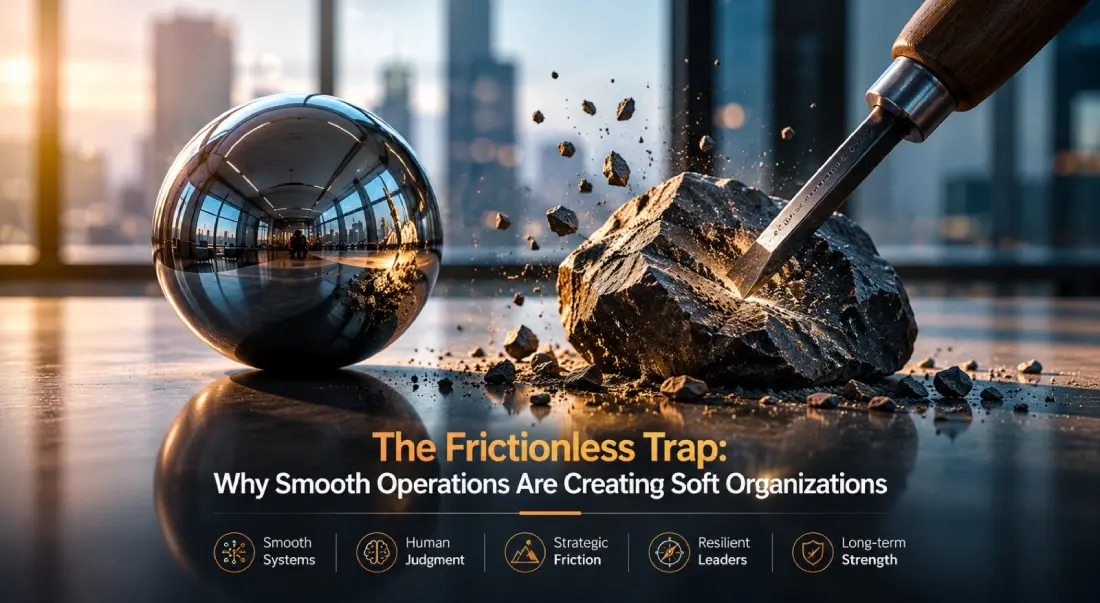
The dashboard was green.
Every KPI looked healthy.
Every workflow was automated.
Every customer complaint was routed, resolved, and documented before a human manager even noticed there was a problem.
On paper, it looked like the pinnacle of operational excellence.
The modern enterprise had finally achieved what corporations spent decades chasing:
A perfectly frictionless machine.
But beneath the polished dashboards and seamless workflows, something dangerous has quietly started happening inside organizations around the world.
The people themselves are becoming soft.

The Silent Side Effect of Automation
We are entering an era where intelligent systems absorb nearly every operational rough edge.
AI predicts supply chain disruptions before they happen.
Automated workflows remove bottlenecks before teams even feel the pressure.
Internal copilots draft responses, summarize meetings, recommend decisions, and optimize communication.
The modern workplace is becoming incredibly efficient.
But efficiency has a hidden psychological cost.
Drawing from observations made during leadership workshops conducted by Manoj Gupta, a troubling pattern keeps emerging among modern management teams:
Many teams no longer have the stamina for unresolved tension.
Because the system catches every mistake, people rarely sit inside genuine uncertainty anymore.
Managers are becoming increasingly unfamiliar with:
- operational messiness,
- incomplete information,
- high-pressure ambiguity,
- and uncomfortable decision-making.
Then eventually, reality breaks through the automated shell.
A market shock happens.
A reputational crisis erupts.
A supply chain collapses unexpectedly.
A product launch fails publicly.
And suddenly the room panics.
Not because the people are unintelligent - but because they have not exercised their resistance muscles in years.
The Gym of Discomfort
We have forgotten a basic law of human development:
Muscle only grows when it encounters resistance.

If you enter a gym and lift weights with no tension, your body never adapts.
Strength is built through controlled strain.
The same principle applies to leadership.
When organizations remove every operational hardship from the daily experience of managers, they unintentionally weaken the very people responsible for navigating future crises.
A generation of leaders is emerging that knows how to operate smooth systems…
…but struggles the moment the system stops behaving smoothly.
This is the paradox of over-optimization:
The more frictionless the environment becomes, the less resilient the humans inside it often become.
A powerful real-world example emerged during the Boeing 737 MAX crisis. As aviation systems became increasingly automated, pilots had fewer opportunities to manually exercise high-pressure emergency instincts in real-world conditions.
When the automated MCAS system malfunctioned unexpectedly, investigations later revealed concerns around automation dependency, insufficient training exposure, and the dangerous gap forming between human judgment and machine-managed operations. Detailed analysis from the IEEE and the Association for Computing Machinery (ACM) highlighted how over-optimized systems can unintentionally weaken human adaptability during moments of real crisis.
The Ancient Principle We Forgot
Ancient craftsmanship understood something modern corporate culture is beginning to forget:
Nothing becomes sharp without resistance.
| Craft | What Creates Strength? | Leadership Equivalent |
|---|---|---|
| Diamond | Friction and polishing | Constructive feedback and challenge |
| Sword | Fire and pressure | High-stakes responsibility |
| Sculpture | Chisel striking stone | Difficult decisions and accountability |
| Athlete | Resistance training | Operational adversity and problem-solving |
| Leader | Discomfort and uncertainty | Growth in judgment and resilience |
Growth has always required collision.
Yet modern organizations increasingly treat discomfort as something to eliminate entirely.
Every difficult conversation gets softened.
Every disagreement gets politically neutralized.
Every operational challenge gets automated away.
But organizations that eliminate all friction eventually eliminate resilience itself.
Real-World Example: During Intel's rise under Andy Grove, leaders actively encouraged rigorous debate and constructive confrontation rather than artificial agreement. The belief was simple: strong ideas become stronger when challenged, while weak ideas fail before they become costly mistakes.
Strategic Friction: The Leadership Advantage
The strongest leaders I work with are beginning to understand an important distinction:
Technology should remove repetitive friction - not developmental friction.
That difference changes everything.
The purpose of automation should not be to protect leaders from thinking.
Its purpose should be to free human beings for deeper judgment, sharper decision-making, and more meaningful problem-solving.
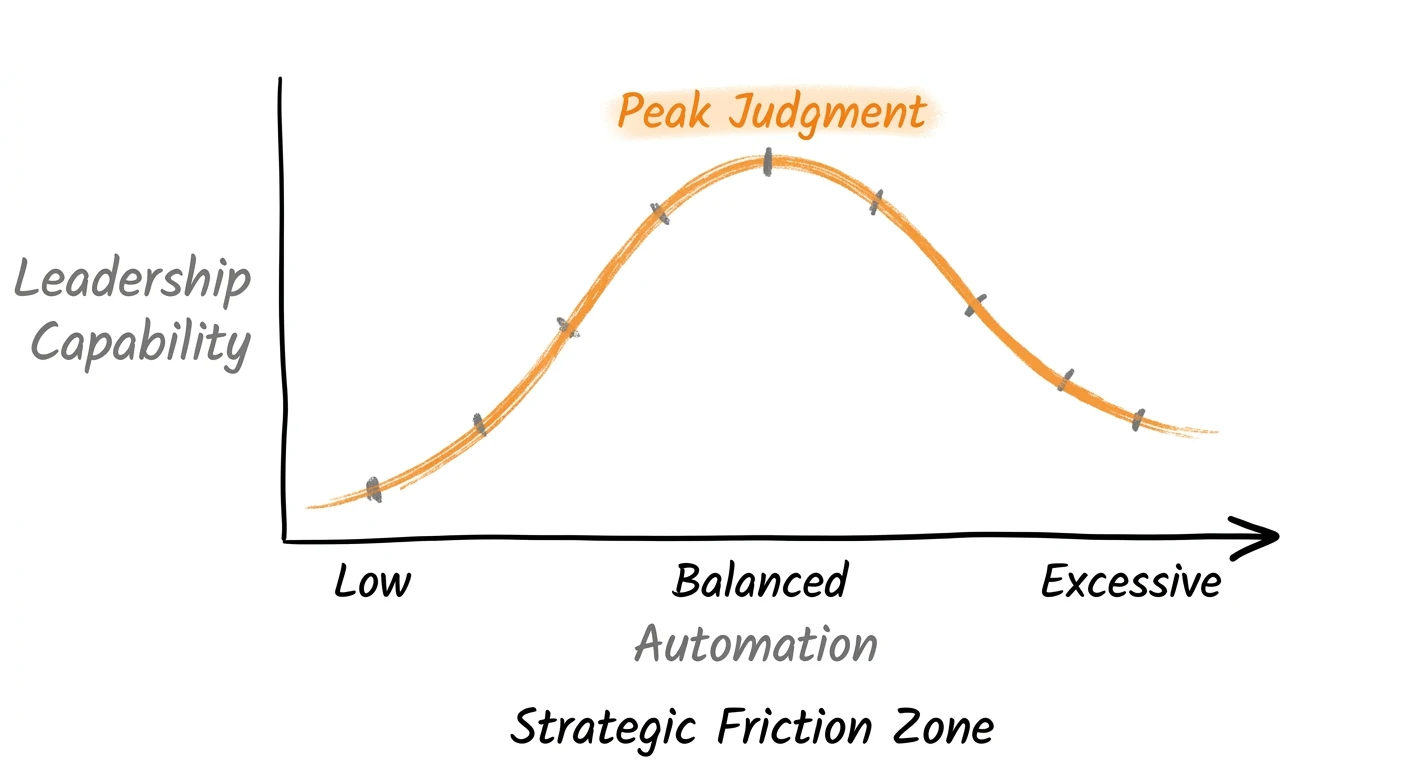
This is where Strategic Friction becomes essential.
Strategic Friction means intentionally preserving certain forms of challenge inside the organization so people continue developing resilience, adaptability, and independent thinking.
Not chaos.
Not dysfunction.
Not bureaucracy.
But controlled resistance.
Because without resistance, leadership muscles slowly atrophy.
Real-World Example: At Toyota, workers are empowered to pull the famous "Andon Cord" and stop an entire production line when they detect a problem. Rather than hiding friction, the system deliberately exposes issues so teams can learn, improve, and strengthen operational judgment.
How Strong Organizations Practice Strategic Friction
1. Stop Pre-Solving Every Problem
When operational problems emerge, many leaders immediately rely on AI-generated recommendations before the team has even processed the situation themselves.
That creates dependency.
Instead, sometimes present the raw dilemma directly to managers.
Let them wrestle with ambiguity.
Let them debate incomplete information.
Let them build judgment before receiving optimization.
The struggle itself is part of the training.
2. Run “Manual Mode” Simulations
Once every quarter, temporarily remove the automated safety net.
Run simulations where teams must navigate complex situations using:
- human collaboration,
- strategic thinking,
- and decision-making under pressure.
No copilots.
No automation-first workflows.
No instant optimization.
Just human capability under stress.
Organizations that rehearse discomfort become far more stable during real crises.
3. Stop Over-Smoothing Healthy Conflict
Modern corporate culture often treats disagreement as a threat to harmony.
But thoughtful friction is where innovation is born.
When intelligent people challenge each other honestly, better ideas emerge.
Not every heated discussion needs immediate corporate diplomacy.
Sometimes the tension itself is productive.
Some of the strongest breakthroughs happen after difficult conversations - not comfortable ones.
The Rise of the Rugged Organization
When companies embrace Strategic Friction, something powerful begins to change internally.
People stop fearing problems.
They stop collapsing under uncertainty.
They stop depending entirely on systems for clarity.
Instead, they become mentally rugged.
The organization develops confidence not because everything is smooth…
…but because the people know they can survive when things are not.
| Efficiency Focus | Resilience Focus |
|---|---|
| Automation | Adaptability |
| Optimization | Judgment |
| Consistency | Recovery |
| Speed | Learning |
| Process Reliability | Human Capability |
That distinction matters enormously in the AI era.
Because the future will not belong to organizations with the smoothest dashboards.
It will belong to organizations whose people can still think clearly when the dashboard fails.
Reflection for Leaders
If friction is essential for growth, an important question remains:
How much healthy resistance still exists inside your organization?
Do your managers regularly exercise judgment under uncertainty?
Can your teams operate effectively when systems fail, information is incomplete, or the path forward is unclear?
Or has convenience quietly replaced capability?
To explore these questions further, you may find value in taking the Consciouspreneur Leadership Assessment, designed to help leaders evaluate the balance between efficiency, adaptability, and human judgment in an increasingly automated world.
FAQ
What is Strategic Friction in leadership and organizations?
Strategic Friction is the intentional introduction of healthy challenges, ambiguity, and resistance inside an organization to strengthen problem-solving, resilience, and independent thinking. Instead of removing every difficulty through automation, leaders preserve certain moments of discomfort to help teams develop stronger decision-making abilities.
Why can highly automated companies become fragile?
Highly automated companies often reduce the amount of real-world problem-solving employees experience daily. Over time, teams become dependent on systems, workflows, and AI-generated recommendations. When unexpected crises occur, many employees struggle because they haven’t practiced operating under uncertainty or pressure.
Does automation weaken leadership skills?
Automation itself is not the problem. The issue arises when organizations use technology to eliminate every form of friction, challenge, or critical thinking. Strong leadership skills are developed through difficult decisions, unresolved tension, and navigating uncertainty - experiences that excessive automation can unintentionally reduce.
What is the difference between operational efficiency and organizational resilience?
Operational efficiency focuses on speed, optimization, and smooth execution. Organizational resilience focuses on adaptability, mental toughness, and the ability to perform under disruption or crisis. A company can be highly efficient while still lacking resilience if its people are not trained to handle unexpected challenges.
How can companies build resilient teams in the AI era?
Companies can build resilient teams by combining technology with intentional leadership development practices such as:
- encouraging independent problem-solving,
- allowing healthy debate,
- running manual simulations,
- exposing managers to uncertainty,
- and avoiding over-dependence on AI-generated decisions.
The goal is to use technology as support - not as a replacement for human judgment.
References
- Research on organizational resilience, operational uncertainty, and adaptive leadership - MIT Sloan Management Review
MIT Sloan Executive Education – Building Organizational Resilience - Insights on preserving human judgment and leadership decision-making in the age of AI - Harvard Business Review / Harvard Business Impact
The Irreplaceable Value of Human Decision-Making in the Age of AI - Research and discussions around AI dependency, human oversight, and resilience in automated systems - Reddit Engineering & AI Communities
Human Judgment, AI Assistance – Reddit Discussion
Human-in-the-Loop Governance Discussion – Reddit
Set the Trajectory
There are no reflections on this insight yet. Be the first to initiate the dialogue and share your perspective with the community.


Did this insight shift your perspective?
If this article resonated with you, what is one change or practice you will introduce to your workflow or leadership style moving forward? Share your commitment below.