The Synthetic Empathy Trap: How AI-Generated Corporate Communication is Killing Employee Trust
By Manoj Gupta, Founder
- A Strange New Corporate Language
- The Synthetic Empathy Trap
- The Rise of AI-Generated Corporate Communication
- Employees Can Feel the Difference
- The Trust Crisis Inside Modern Organizations
- Human Leadership vs AI-Optimized Communication
- The Fear of Unfiltered Leadership
- The Unpolished Mirror
- What Authentic Leadership Looks Like in the AI Era
- How Leaders Can Rebuild Employee Trust
- Human Presence Will Become the New Leadership Advantage
- Reflection for Leaders
- FAQ
- References
A Strange New Corporate Language
In 2023, people across the internet began noticing something unsettling about corporate communication.
Layoff emails…
CEO apologies…
HR announcements…
Internal restructuring notes…
Many of them sounded strangely similar.
Perfectly balanced.
Emotionally polished.
Carefully empathetic.
And somehow… emotionally empty.
The conversation intensified after companies faced public backlash over increasingly impersonal leadership communication during layoffs and restructuring. In one widely discussed case, Atlassian faced criticism after using a pre-recorded layoff announcement video that many employees described as emotionally distant and detached.
On platforms like Reddit and LinkedIn, employees described leadership messages as:
- “robotic”
- “performative”
- “emotionally engineered”
- “written by ChatGPT”
One viral discussion emerged after employees suspected that a company-wide restructuring message had been heavily AI-assisted. The wording was flawless, compassionate, and psychologically optimized.
But instead of calming people, it triggered distrust.
Employees said the message felt less like human leadership and more like “corporate emotional automation.”
That reaction points to a deeper shift happening inside modern organizations.
For the first time in history, companies can now automate empathy at scale.
And in the process, they may be quietly destroying the very thing leadership depends on most:
Trust.
I call this phenomenon:
The Synthetic Empathy Trap
The Synthetic Empathy Trap happens when organizations use AI-generated emotional communication so extensively that people stop believing the humanity behind the message.

The communication sounds caring.
But it no longer feels real.
And humans are extraordinarily sensitive to emotional authenticity.
Especially during moments of uncertainty.
The Rise of AI-Generated Corporate Communication
Modern executives are under enormous pressure.
Every internal message now carries risk:
- legal risk
- reputational risk
- HR risk
- social media risk
- employee backlash risk
As a result, many organizations are increasingly relying on AI tools to draft:
- restructuring announcements
- burnout responses
- apology emails
- DEI statements
- crisis communication
- leadership memos
- performance feedback
- employee engagement messaging
Even public conversations around AI-generated apologies and workplace messaging reveal a similar pattern: people may appreciate the convenience of artificial intelligence, but they still instinctively search for signs of authentic human emotion behind important conversations. A growing body of workplace research now suggests that employees often perceive AI-written communication as less trustworthy and emotionally authentic. A recent Euronews report highlighted how AI-written workplace emails may reduce trust between employees and leadership.
On the surface, this appears useful.
But beneath the convenience lies a deeper question:
What happens when emotional expression becomes algorithmically manufactured?

Because leadership communication is not merely about information transfer.
It is about emotional trust.
And trust cannot be fully automated.
Employees Can Feel the Difference
Many executives underestimate something fundamental:
Employees are not evaluating words alone.
They are evaluating energetic congruence.
People instinctively ask:
- Does this sound human?
- Does this feel lived?
- Is this emotionally honest?
- Did this leader actually sit with this pain?
- Or was this optimized by a machine?
And increasingly, employees can sense the difference.
A growing workplace trust crisis is already emerging around invisible AI usage in professional communication.
Even outside corporations, public reactions reveal the same emotional pattern.
In online discussions about AI-generated apologies, many users described them as emotionally insulting because the sender “couldn’t even bother writing it themselves.”
The issue is not technological assistance itself.
The issue is emotional outsourcing.
When leaders outsource emotional presence, communication becomes performative rather than relational.
And people can feel it immediately.
The Trust Crisis Inside Modern Organizations
Today, many organizations are facing a paradox:
They are communicating more carefully than ever before…
while simultaneously becoming less trusted.
A recent report on workplace trust highlighted how performative leadership communication and ethical inconsistencies are driving employee disengagement and resignation.
At the same time, new research from Workday found that while AI may reduce burnout and improve productivity, it may also deepen loneliness and emotional disconnection inside workplaces.
This is not accidental.
Human beings do not build trust through polished language alone.
Trust is built through:
- emotional risk
- visible honesty
- imperfect sincerity
- shared uncertainty
- authentic presence
And the “scores” can reflect how much these qualities are present in highly optimized corporate environments.
Example conceptual values:
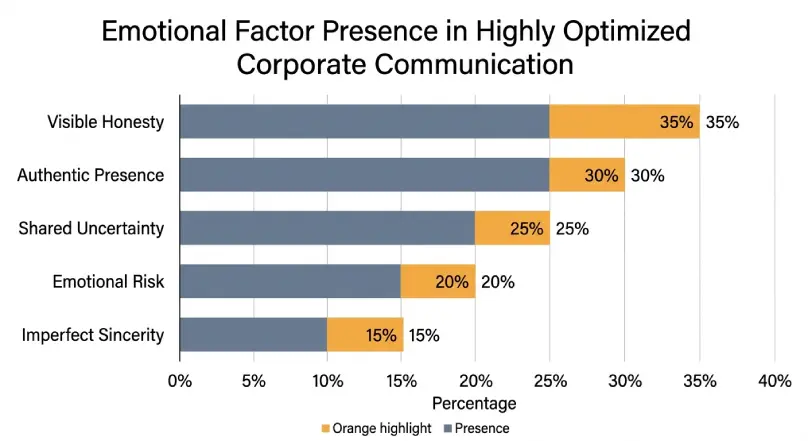
Ironically, the more optimized leadership communication becomes, the more emotionally sterile it can feel.
And sterile communication slowly kills organizational culture.
Human Leadership vs AI-Optimized Communication
| Aspect | Human-Centered Leadership | AI-Optimized Corporate Communication |
|---|---|---|
| Emotional Tone | Imperfect but genuine | Polished and optimized |
| Trust Building | Built through authenticity | Often perceived as performative |
| Response During Crisis | Honest and emotionally present | Risk-managed and carefully scripted |
| Employee Perception | Human and relatable | Robotic or emotionally distant |
| Communication Style | Personal and adaptive | Standardized and pattern-driven |
| Vulnerability | Allows uncertainty | Avoids emotional risk |
| Leadership Presence | Felt emotionally | Simulated linguistically |
| Long-Term Impact | Builds loyalty and culture | May create emotional disengagement |
| Best Use Case | Crisis leadership, trust-building | Operational updates, scalability |
| Core Outcome | Human connection | Communication efficiency |
The Fear of Unfiltered Leadership
Most executives are not trying to deceive people.
They are trying to avoid mistakes.
That is the deeper issue.
Modern leadership culture increasingly fears:
- saying the wrong thing
- appearing uncertain
- showing vulnerability
- expressing imperfect emotion
- sounding unscripted
So organizations smooth every edge.
Every sentence gets filtered through:
- PR
- HR
- legal review
- executive review
- AI optimization
- sentiment calibration
Eventually, the human disappears entirely.
What remains is emotionally optimized language without emotional reality.
But leadership was never meant to be flawless performance art.
Real leadership has texture.
It contains uncertainty.
It contains visible humanity.
It contains moments where people can feel:
“This person is actually here with us.”
That feeling cannot be generated through predictive language systems alone.
The Unpolished Mirror
To solve this modern problem, we may need to revisit an ancient principle.
I call it: The Unpolished Mirror.
In many wisdom traditions, the mirror symbolizes truthful presence.
A mirror does not manipulate reality.
It reflects what is actually there.
If the sky is stormy, the mirror reflects the storm.
It does not generate artificial sunshine to maintain emotional comfort.
That is precisely what many organizations have lost.
They no longer communicate reality.
They communicate emotional risk management.
And employees can sense the gap instantly.
The Unpolished Mirror approach to leadership means:
- speaking honestly even when answers are incomplete
- acknowledging uncertainty
- resisting over-optimization
- prioritizing sincerity over perfection
- allowing communication to sound human

Sometimes the most trustworthy sentence a leader can say is:
“I don’t fully know yet, but I want to be transparent with you.”
Paradoxically, honest uncertainty often builds more trust than polished certainty.
What Authentic Leadership Looks Like in the AI Era
The future does not require rejecting AI.
AI is incredibly useful for:
- operational efficiency
- data analysis
- summarization
- workflow optimization
- administrative communication
But critical human moments should remain deeply human.
Especially:
- layoffs
- grief
- burnout
- conflict
- apology
- emotional repair
- vision-setting
- organizational uncertainty
In those moments, leaders must resist the temptation to sound perfect.
Because employees are not searching for perfect executives.
They are searching for psychologically real leaders.
The leaders who build lasting loyalty are rarely the most polished.
They are the most emotionally believable.
How Leaders Can Rebuild Employee Trust
1. Write Difficult Messages Yourself
Use AI for structure if necessary.
But the emotional core should come from you.
Employees can feel when words carry lived emotional weight.
2. Stop Over-Engineering Town Halls
Many corporate town halls now feel emotionally artificial because every moment is pre-managed.
Sometimes leaders should simply stand up and speak plainly.
Without the performance layer.
3. Acknowledge Uncertainty Openly
Trust is not built through pretending to know everything.
Trust is built through visible honesty.
4. Respond Like a Human, Not a Brand
Employees do not want to feel managed during emotional moments.
They want to feel seen.
5. Let Communication Retain Human Texture
A slightly imperfect message written honestly often creates more trust than a perfectly optimized corporate statement.
Human Presence Will Become the New Leadership Advantage
As AI-generated communication becomes universal, authentic human presence will become increasingly rare.
And rarity creates value.

Soon, employees may not remember which executive had the most polished messaging strategy.
But they will remember:
- who spoke honestly
- who stayed emotionally present
- who acknowledged reality directly
- who sounded human during difficult moments
That is the future competitive advantage of leadership.
Not synthetic empathy.
Human depth.
Reflection for Leaders
As AI-generated communication becomes increasingly polished, an important question begins to emerge:
Can your people still feel genuine human presence inside your leadership culture?
Do your employees experience authentic trust…
or carefully optimized communication?
Has efficiency started replacing emotional sincerity?
And perhaps most importantly:
If every message sounds emotionally perfect…
will people still believe it is real?
To explore these questions further, you may find value in taking the Consciouspreneur Leadership Assessment, designed to help leaders evaluate trust, authenticity, emotional intelligence, and human-centered leadership in an increasingly automated world.
FAQ
What is synthetic empathy in corporate communication?
Synthetic empathy refers to emotionally optimized communication generated or heavily shaped by AI systems rather than authentic human emotional expression.
Why do employees distrust AI-generated leadership messages?
Employees often sense when communication feels overly polished, emotionally engineered, or disconnected from genuine human experience, especially during crises or organizational stress.
Is AI bad for workplace communication?
Not necessarily. AI is extremely useful for operational efficiency and communication support. The problem arises when organizations replace authentic emotional leadership with automated emotional performance.
How can leaders maintain authenticity in the AI era?
Leaders can maintain authenticity by communicating transparently, speaking honestly during uncertainty, reducing over-scripted messaging, and staying emotionally present during difficult moments.
What is authentic leadership in modern organizations?
Authentic leadership involves emotional honesty, transparency, vulnerability, ethical consistency, and genuine human connection rather than performative corporate communication.
References
- Workday Research on AI and Workplace Connection
- AI & Society Research on AI Apologies
- Microsoft Work Trend Index on AI, Human Agency, and the Future of Work
Set the Trajectory
There are no reflections on this insight yet. Be the first to initiate the dialogue and share your perspective with the community.


Did this insight shift your perspective?
If this article resonated with you, what is one change or practice you will introduce to your workflow or leadership style moving forward? Share your commitment below.