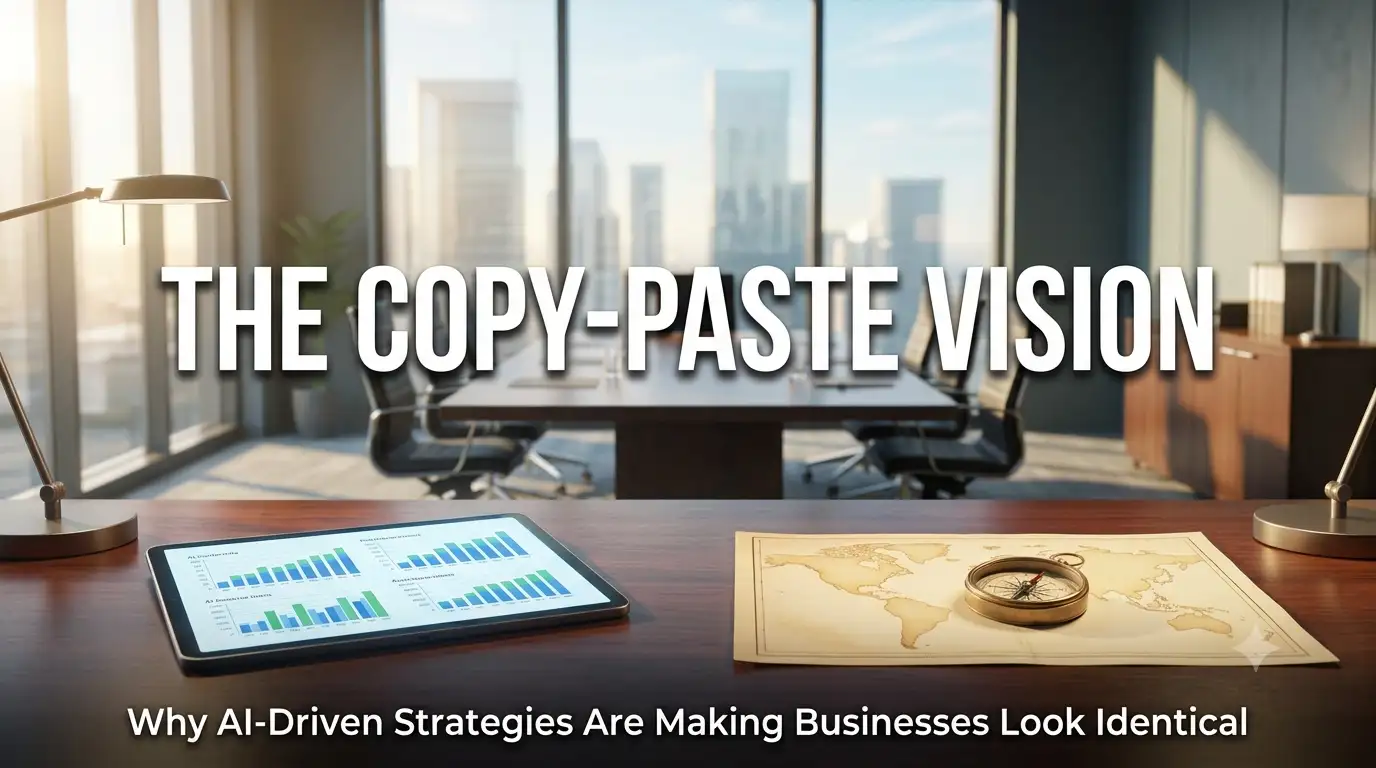
The Copy-Paste Vision: Why AI-Driven Strategies Are Making Businesses Look Identical

The Copy-Paste Vision: Why AI-Driven Strategies Are Making Businesses Look Identical
Table of Contents

"If this fails, I could lose my job."

That wasn't a dramatic line from a Hollywood screenplay.

It was the very real fear of Netflix's Chief Content Officer, Ted Sarandos.

Around 2011, Netflix stood at a crossroads. It had built a successful streaming platform by licensing movies and television shows from major studios. The business model was working. The numbers looked promising. The data supported staying the course.

Then came an audacious proposal.

Instead of merely distributing content, Netflix would become a creator.

The company committed nearly $100 million to produce House of Cards - not after a successful pilot episode, not after audience testing, but before a single frame had been shot.

There were no ratings to analyse.

No historical benchmarks.

No guarantee that audiences would accept Netflix as a studio.

Years later, Sarandos admitted he genuinely believed the decision could cost him his job if it failed.

The gamble changed the entertainment industry forever.

Today, when people discuss Netflix's success, they often credit its powerful algorithms and recommendation engine.

But algorithms didn't create Netflix Originals.

Leadership did.

Data helped identify an opportunity.

Conviction transformed it into history.

And that distinction has never been more important than it is today.

The Age of Perfect Predictions

For the first time in business history, leaders can ask artificial intelligence almost anything.

  • Which customer segment is growing fastest?
  • Which product category will gain momentum next quarter?
  • Which marketing message is most likely to convert?
  • Which markets deserve expansion?
  • Which skills should companies hire for?

Within seconds, AI delivers reports backed by millions of data points, predictive analytics, and probability scores.

It feels almost magical.

Every dashboard promises certainty.

Every trend report promises clarity.

Every recommendation promises reduced risk.

For executives facing increasing pressure to make faster decisions, AI has become one of the most valuable strategic companions ever created.

Manoj Gupta, a consciouspreneur and human-centered business leader, presenting at a professional corporate workshop.
Photo from manojgupta.com

Leadership mentor Manoj Gupta has consistently argued that while technology can improve the quality of information available to leaders, it should never become a substitute for human wisdom. In today's AI-driven business environment, the real challenge is no longer accessing better data - it is developing the clarity and courage to make decisions that go beyond what algorithms can recommend.

Yet something unexpected is happening.

Walk into boardrooms across industries today.

Read annual reports.

Browse startup pitch decks.

Study product launches.

Listen to marketing campaigns.

A strange pattern begins to emerge.

Everyone sounds remarkably similar.

The Rise of the Copy-Paste Vision

Artificial intelligence has democratized intelligence.

Unfortunately, it has also democratized conformity.

When every company asks similar questions...

...using similar AI tools...

...trained on similar datasets...

...they begin receiving remarkably similar answers.

Soon, everyone starts chasing the same trends.

Everyone builds similar products.

Everyone adopts similar messaging.

Everyone claims to be "customer-centric," "AI-powered," "future-ready," and "innovative."

Ironically, the more businesses optimise themselves using identical data sources, the more they resemble one another.

They become statistically efficient.

But strategically forgettable.

A row of identical generic geometric models or objects lined up precisely, representing corporate conformity and a copy-paste vision.
Photo by luthfi alfarizi on Unsplash

The greatest risk facing modern organizations may no longer be making the wrong decision.

It may be making the exact same decision as everyone else.

When Data Stops Being Your Competitive Advantage

There was a time when possessing more information than your competitors created an enormous advantage.

That era is ending.

Today, AI platforms, market intelligence tools, consumer insights, and predictive analytics are widely available.

Your competitors can access nearly the same information you can.

If everyone possesses similar intelligence...

where does competitive advantage come from?

Not from having better dashboards.

Not from producing more reports.

Not from collecting another million rows of data.

Competitive advantage now shifts toward something technology cannot manufacture.

Vision.

Judgment.

Purpose.

Conviction.

These qualities do not emerge from algorithms.

They emerge from leaders.

Comparison Between Copy-Paste Vision and Future-Ready Leadership

Many organizations rely on the same AI tools, market reports, and predictive analytics, resulting in remarkably similar strategies. Future-ready leaders, however, use these insights differently. They combine technology with human judgment, creativity, and purpose to build businesses that stand apart rather than fit in.

Copy-Paste Vision

Vision-Led Leadership

Asks: "What is everyone else doing?"

Asks: "What future can we create?"

Waits for trends to be validated.

Creates trends before they become obvious.

Uses AI to avoid mistakes.

Uses AI to uncover possibilities while embracing calculated risks.

Follows consensus.

Challenges consensus with conviction.

Protects the existing business.

Reinvents the business before someone else does.

Competes on efficiency.

Competes on originality and purpose.

Leads with probability.

Leads with possibility.

Data Can Predict Patterns. It Cannot Create Possibilities.

Artificial intelligence excels at identifying patterns.

It analyses yesterday to estimate tomorrow.

It discovers relationships hidden inside enormous datasets.

It recognizes probabilities faster than any human mind.

But every prediction has one invisible limitation.

It depends on something that has already existed.

An open antique, blank map alongside an old-fashioned compass, symbolizing historical patterns, human vision, and navigating the unknown landscape.
Photo by Eduardo Casajús Gorostiaga on Unsplash

History.

Patterns.

Behaviour.

Evidence.

Innovation rarely begins there.

Consider some of history's defining business breakthroughs.

They did not emerge because data demanded them.

They emerged because someone imagined a future the numbers could not yet validate.

Every category-defining company first looked unreasonable.

Every revolutionary idea initially appeared uncertain.

Every major breakthrough lived in a place where data had little to say.

Because data explains the known world.

Vision creates the unknown one.

The Unprinted Map

Ancient explorers rarely possessed complete maps.

Much of the world remained blank.

Cartographers literally left empty spaces where knowledge ended.

Yet explorers sailed anyway.

Not because they ignored reality.

Because they refused to let incomplete knowledge define possibility.

They followed something greater than certainty.

They followed conviction.

Modern business leaders face a surprisingly similar challenge.

Artificial intelligence maps existing knowledge beautifully.

It highlights probabilities.

It reveals patterns.

It reduces uncertainty.

But every great opportunity still exists beyond the printed map.

The future has never been fully documented.

Someone must still choose to explore it.

The Leadership Trap Nobody Is Talking About

Many organizations proudly describe themselves as "data-driven."

Very few ask whether they have accidentally become "data-dependent."

There is an important difference.

A data-driven leader uses information to make better decisions.

A data-dependent leader waits for information before making any decision.

One uses data as a compass.

The other mistakes it for the destination.

When organizations lose confidence in human judgment, innovation begins slowing down.

Meetings become exercises in seeking validation instead of exploring possibilities.

Teams stop asking:

"What could we build?"

They begin asking:

"What does the dashboard recommend?"

That subtle shift changes everything.

Human Conviction: The Last Unfair Advantage

As AI becomes more accessible, technical capability will become increasingly equal.

Close-up of integrated circuits and circuit board pathways, representing automation dependency, advanced technology workflows, and the digital landscape.
Photo by Bhautik Patel on Unsplash

Every organization will have intelligent assistants.

Every organization will automate workflows.

Every organization will analyse customer behaviour.

Every organization will optimize operations.

Technology will become expected.

Not exceptional.

The organizations that stand apart will possess something machines cannot replicate.

A distinctive philosophy.

A compelling purpose.

The courage to disagree with consensus.

The willingness to pursue ideas before evidence becomes overwhelming.

In other words...

Human conviction becomes the last unfair advantage.

How Leaders Can Avoid the Copy-Paste Vision

The answer is not rejecting AI.

The answer is leading it.

Here are five practices every modern leader should adopt.

1. Let AI Inform Decisions—Not Make Them

Use predictive intelligence to understand the landscape.

Never allow it to replace strategic thinking.

Data should advise.

Leadership should decide.

2. Ask Questions AI Cannot Answer

Instead of asking,

"What is the fastest-growing market?"

Ask,

"What future do we want to create that doesn't exist yet?"

The second question requires imagination.

Not prediction.

3. Protect Your Company's Identity

Before studying competitors...

Before reading trend reports...

Before opening dashboards...

Revisit your organization's core purpose.

Technology should amplify identity.

Not replace it.

4. Reward Original Thinking

If employees are only rewarded for making "safe" decisions, they will naturally follow consensus.

Create space where thoughtful experimentation is celebrated.

Even when outcomes remain uncertain.

Innovation grows in psychological safety.

Not statistical certainty.

5. Build an Organization That Thinks Beyond Trends

Trend-followers survive.

Category creators redefine industries.

Encourage teams to ask one simple question during strategic discussions:

"If everyone follows this recommendation, what opportunity will nobody notice?"

That single question often reveals entirely new markets.

Beyond Artificial Intelligence Lies Human Wisdom

Artificial intelligence represents one of humanity's greatest technological achievements.

Ignoring it would be irresponsible.

Blindly following it may be equally dangerous.

Technology has always expanded human capability.

It has never replaced human purpose.

History rarely remembers the organizations that perfectly followed existing trends.

It remembers those that created new ones.

Netflix didn't simply analyse entertainment.

It reimagined it.

Every legendary company eventually stepped beyond the printed map.

A professional business leader in a suit adjusting his cuffs, symbolizing strategic execution, vision-led leadership, and professional excellence.
Photo by Hunters Race on Unsplash

The next generation of market leaders will do the same.

Not because they ignored data.

But because they refused to become prisoners of it.

Reflection for Leaders

Artificial intelligence can tell you where the crowd is going.

It can estimate demand.

Predict behaviour.

Reduce uncertainty.

Optimize execution.

These are extraordinary capabilities.

But they are available to everyone.

Your real advantage has never been access to information.

It has always been the courage to interpret that information differently.

Data discovers patterns.

Vision creates futures.

Use AI to understand where everyone else is standing.

Then look toward the unprinted map.

Because history has never been written by those who simply followed directions.

It has always been written by those courageous enough to draw new ones.

FAQ

What is a Copy-Paste Vision in business?

A Copy-Paste Vision is a leadership approach where organizations rely heavily on the same AI tools, market trends, and data-driven insights as their competitors. As a result, businesses often develop similar strategies, products, and messaging instead of building a distinctive identity and competitive advantage.

Can AI replace human decision-making in leadership?

No. AI is highly effective at analyzing data, identifying patterns, and forecasting trends, but it cannot replace human qualities such as vision, judgment, creativity, ethics, and intuition. The most successful leaders use AI to support decisions while relying on their own conviction to shape the future.

How can businesses use AI without losing originality?

Organizations should use AI as a strategic advisor rather than the final decision-maker. By combining AI-driven insights with a clear purpose, strong values, and innovative thinking, businesses can make informed decisions while preserving their unique identity and long-term vision.

Why are many AI-driven business strategies becoming similar?

Most AI platforms learn from large volumes of historical and publicly available data. When companies ask similar questions using similar tools, they often receive comparable recommendations. Without independent thinking, businesses risk following the same trends instead of creating new opportunities.

What is the biggest competitive advantage in the AI era?

As AI becomes widely accessible, technology alone is no longer enough to differentiate a business. The true competitive advantage comes from visionary leadership, original thinking, purpose-driven decision-making, and the courage to pursue opportunities that data alone cannot predict. These human qualities enable organizations to become market creators rather than market followers.

References


Did this insight shift your perspective?

If this article resonated with you, what is one change or practice you will introduce to your workflow or leadership style moving forward? Share your commitment below.

Set the Trajectory

There are no reflections on this insight yet. Be the first to initiate the dialogue and share your perspective with the community.