We are sorry to see you go. Are you sure you want to delete your account?
By Manoj Gupta, Founder
Why the fastest organizations may produce the weakest leaders-and how to reclaim the one human capability AI cannot replace.
In 2024, Klarna became one of the world's biggest success stories in AI adoption. Its AI assistant handled the work of hundreds of customer service agents, helping the company cut costs and dramatically improve efficiency.
But within months, the conversation changed.
CEO Sebastian Siemiatkowski admitted the company had "over-indexed" on automation and began shifting back toward greater human involvement, recognizing that speed and cost savings could not fully replace judgement, empathy, and service quality.
If you're interested in the story, Reuters covered the CEO's remarks here: Reuters interview with Klarna CEO
This wasn't a failure of artificial intelligence.
It was a reminder that automation can accelerate execution, but it cannot manufacture wisdom.
And that raises a far more important question for every leader today:
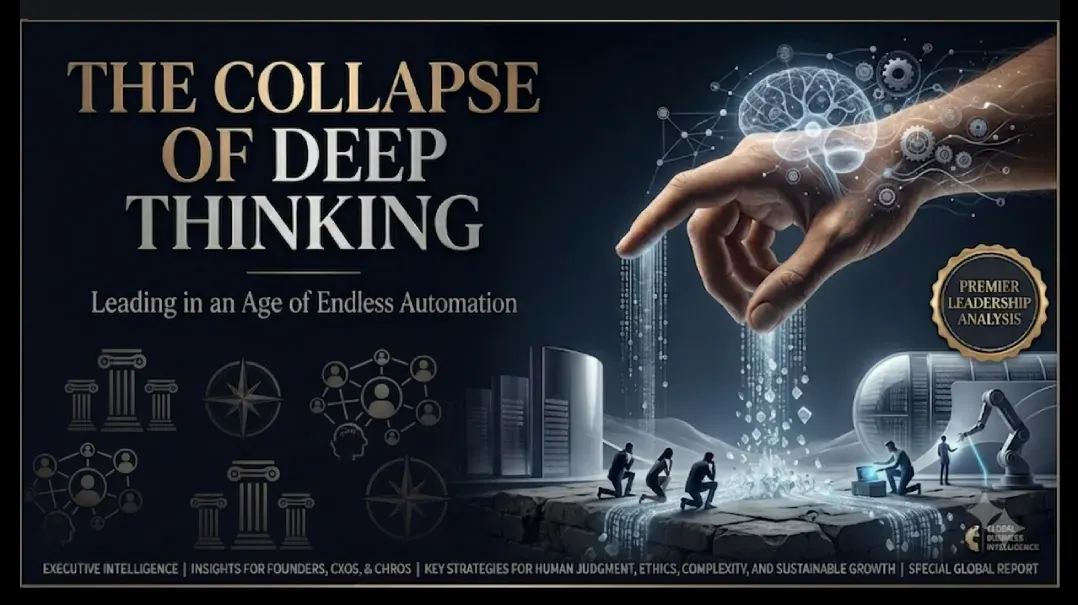
If AI keeps doing more of our thinking, are we quietly losing the ability to think deeply ourselves?
Artificial intelligence has transformed the way organizations work. Reports that once took days to prepare are now summarized in seconds. Market trends are analyzed almost instantly. Presentations, emails, proposals, and even strategic recommendations can be generated with a single prompt.
On paper, today's leaders have access to more intelligence than any generation before them.
Yet something feels strangely different inside many boardrooms.
Meetings are becoming faster, but not necessarily better. Teams consume more information than ever before, yet fewer people pause to question assumptions, challenge prevailing opinions, or explore uncomfortable possibilities. Decisions are increasingly informed by data, but not always strengthened by wisdom.
The irony is difficult to ignore.
We have removed friction from work, but we may also be removing the very friction that produces insight.
Leadership has never been about collecting the most information. It has always been about making sense of complexity, navigating uncertainty, and exercising judgement when there is no obvious answer.
Those abilities cannot be downloaded, summarized, or automated.
They must be developed.
Unfortunately, modern work is training us in the opposite direction.
Every notification, instant answer, AI-generated summary, and endless stream of content conditions the mind to seek speed over reflection and convenience over contemplation. Without realizing it, many leaders are becoming exceptionally efficient at consuming knowledge while gradually losing the patience required to create it.
That is the invisible crisis.
It doesn't appear on financial statements or quarterly dashboards.
It appears in organizations that move faster every year but struggle to think further ahead.
Every major technological revolution has changed the role of human effort.
The Industrial Revolution reduced our dependence on physical labour. Machines began lifting what once demanded human strength.
The Internet transformed how we access information. Instead of memorizing facts, we learned how to search for them.
Smartphones went a step further. We stopped remembering phone numbers, directions, birthdays, and even simple calculations because our devices could do it instantly.
Today, Artificial Intelligence is changing something far more fundamental.
It is beginning to outsource our thinking.
This is not necessarily a bad thing. Throughout history, humans have built tools to extend their capabilities. The problem begins when a tool designed to support thinking slowly replaces the habit of thinking itself.
The real danger of AI is not that it thinks.
The real danger is that we stop thinking before AI starts.
Every time we ask AI to summarize a report we never read, draft an email we never mentally composed, analyse a problem we never fully understood, or generate ideas we never attempted to create ourselves, we save time.
But we also surrender an opportunity to strengthen our own cognitive abilities.
Like muscles, the brain develops through use. If analysis, synthesis, reflection, and problem-solving are consistently delegated elsewhere, those mental capabilities gradually weaken-not because intelligence has disappeared, but because it is no longer being exercised.
This is what I call The Cognitive Outsourcing Model.
| Human Capability | Before the AI Era | Today | Potential Risk |
|---|---|---|---|
| Memory | Remembered facts, numbers, and key information | Search engines and digital tools store everything | Reduced memory recall and mental retention |
| Research | Read complete reports, books, and documents | AI summarizes information in seconds | Loss of context and nuance |
| Analysis | Interpreted data and explored multiple perspectives | AI identifies patterns and generates insights | Reduced critical thinking and independent reasoning |
| Writing | Structured thoughts before expressing them | AI drafts emails, reports, and presentations | Decline in clarity of thinking, because writing shapes thought |
| Decision Support | Relied on mentors, teams, and experience | AI copilots recommend options | Increased confirmation bias if recommendations go unquestioned |
| Judgement | Human wisdom guided final decisions | Still cannot be automated | The defining responsibility of leadership |
Notice the pattern.
Technology has become exceptionally good at helping us remember, retrieve, analyse, and communicate information.
But there is one capability it cannot genuinely own.
Judgement.
Judgement is the ability to weigh competing priorities, understand human consequences, navigate uncertainty, and make decisions when there is no perfect answer. It is shaped by experience, values, emotional intelligence, ethical reasoning, and context-not simply by data.
That is why leadership has never been defined by access to information.
It has always been defined by the quality of judgement applied to that information.
Yet many organizations are unknowingly creating a dangerous imbalance.
They are investing heavily in systems that make execution faster while spending very little time strengthening the minds that must decide what deserves to be executed in the first place.
This raises a question that every executive should ask themselves.
If AI researches your topic, summarizes your documents, analyses your data, drafts your presentation, and recommends your strategy...
At what point do you stop being the thinker and become merely the approver?
That question is not about technology.
It is about leadership.
Because organizations will always need better tools.
But they will never stop needing better judgement.
Before moving to your next task today, pause for a moment and ask yourself:
The answers to these questions may reveal whether you are using AI as a tool-or slowly allowing it to become your substitute.
Technology has not made us less intelligent.
It has made us less patient with thinking.
Today's workplace rewards speed. Every notification, AI prompt, instant summary, and urgent email encourages us to move quickly from one task to another. The problem is that our brains were never designed for continuous switching.
Research by psychologist Dr. Sophie Leroy introduced the concept of Attention Residue-the idea that when we move from one task to another, part of our attention remains attached to the previous activity. In other words, your mind never arrives at the next task with its full capacity.
For leaders, this has serious consequences.
A day filled with meetings, dashboards, AI-generated reports, emails, and notifications may look productive on the calendar. But by evening, the mind has been fragmented into dozens of unfinished thoughts, leaving little energy for the one thing leadership demands most-deep judgement.
The issue is not information overload.
It is attention fragmentation.
Artificial Intelligence has made knowledge instantly accessible. Whenever a problem feels difficult, an answer is only a prompt away.
That convenience is extraordinary-but it also removes something essential.
Many of the best strategic ideas are not born from instant answers. They emerge after questioning assumptions, sitting with uncertainty, and allowing the mind enough uninterrupted time to connect ideas that initially seem unrelated.
AI can accelerate execution.
It cannot accelerate wisdom.
That is why the future advantage of leaders will not depend on who gathers information the fastest. It will depend on who protects the ability to think when everyone else is rushing to respond.
| Fast Work | Deep Thinking |
|---|---|
| Responds quickly | Reflects patiently |
| Consumes information | Creates insight |
| Solves immediate tasks | Solves complex problems |
| Driven by urgency | Guided by purpose |
| Produces output | Produces understanding |
| Optimizes execution | Shapes long-term strategy |
Executive Reflection: Ask yourself, When was the last time I spent one uninterrupted hour thinking about a single strategic problem without checking my phone, email, or AI? If you can't remember, your greatest leadership challenge may not be a lack of information-it may be a lack of uninterrupted thought.
Technology is not the enemy.
In fact, leaders who ignore AI will eventually fall behind. The real challenge is not deciding whether to use artificial intelligence, but when to rely on it and when to rely on yourself.
The leaders who thrive in the next decade will not be those who automate everything. They will be those who consciously protect the mental habits that technology cannot replicate.
That begins with building what I call The Deep Thinking Protocol-a simple set of practices that strengthens judgement instead of replacing it.
| Practice | Purpose | How to Apply |
|---|---|---|
| Think First, Prompt Later | Preserve independent reasoning | Spend 15-20 minutes thinking through a problem before asking AI for assistance. |
| Create Cognitive Enclaves | Protect uninterrupted focus | Block one hour each day with no phone, email, meetings, or AI tools. |
| Read Beyond the Summary | Build cognitive stamina | Regularly read complete books, reports, and research instead of relying only on summaries. |
| Challenge Every Easy Answer | Improve judgement | Ask, "What assumptions could this recommendation be missing?" before accepting any conclusion. |
| Schedule Reflection | Turn experience into wisdom | End each week by writing down three decisions, what influenced them, and what you learned. |
None of these practices require new software or larger budgets.
They require discipline.
Because wisdom has never been created by speed.
It has always been created by reflection.
Artificial Intelligence will continue to become faster, cheaper, and more capable.
It will analyse more data than any human can process. It will generate better reports, smarter forecasts, and increasingly sophisticated recommendations.
But every recommendation will still need someone to ask:
Those questions belong to leaders-not algorithms.
The organizations that succeed in the AI era will not simply be those with the most advanced technology.
They will be the ones led by people who know when to use AI for execution and when to protect the quiet space where judgement, creativity, and wisdom are formed.
Automation can produce answers.
Only a disciplined mind can produce wisdom.
And in an age where almost everyone can generate an answer within seconds, wisdom may become the rarest and most valuable competitive advantage of all.
Artificial intelligence itself is not reducing human intelligence. The real risk arises when we rely on AI for every stage of thinking-from research and analysis to idea generation and decision-making. Used thoughtfully, AI can enhance productivity. Used excessively, it can weaken the mental habits that build critical thinking, creativity, and sound judgement.
Deep thinking is the ability to examine complex problems without rushing to immediate conclusions. It involves reflection, questioning assumptions, connecting ideas, and making decisions despite uncertainty. For leaders, this skill is essential because strategic challenges rarely have simple or obvious answers.
No. AI can process data, identify patterns, and recommend options, but it cannot fully understand organizational culture, ethics, human emotions, long-term vision, or contextual nuances. Judgement remains a uniquely human responsibility and one of the defining qualities of effective leadership.
Leaders can strengthen deep thinking by creating uninterrupted focus time, thinking through problems before consulting AI, reading complete books and reports instead of relying only on summaries, questioning assumptions, and regularly reflecting on important decisions. These habits help develop cognitive resilience and better strategic judgement.
The greatest risk is not that AI will replace leaders-it is that leaders may gradually outsource the very thinking that makes them valuable. Organizations can automate processes and accelerate execution, but they still depend on leaders who can exercise wisdom, navigate ambiguity, and make thoughtful decisions when there is no perfect answer.
There are no reflections on this insight yet. Be the first to initiate the dialogue and share your perspective with the community.
Did this insight shift your perspective?
If this article resonated with you, what is one change or practice you will introduce to your workflow or leadership style moving forward? Share your commitment below.