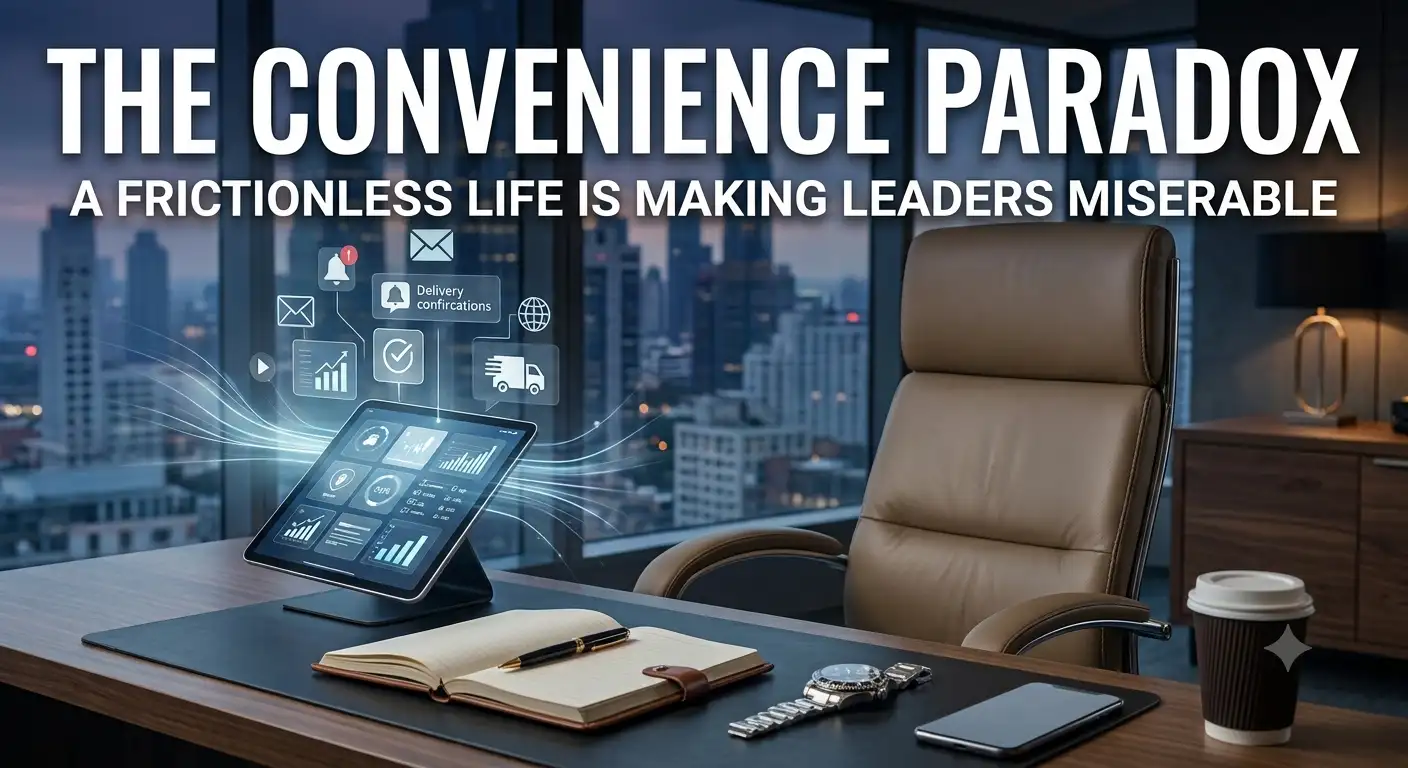
The Convenience Paradox: Why a Frictionless Life is Making Leaders Miserable
By Manoj Gupta, Founder
- The Promise of More Time
- When Convenience Became the Default
- The Psychology of Instant Gratification
- Why Small Delays Feel Bigger Than They Should
- The Hidden Cost of a Frictionless Life
- When We Start Expecting People to Behave Like Technology
- The Leadership Cost of Impatience
- Why Meaningful Things Still Take Time
- The Principle of the Earned Fruit
- The Case for Deliberate Friction
- Relearning the Art of Waiting
- Building the Capacity for the Long Game
- When More Efficiency Creates More Work
- A More Human Definition of Progress
- The Convenience Paradox
- The Leadership Shift
- Frequently Asked Questions (FAQ)
- References
The Promise of More Time
For years, technology has made us a simple promise:
Do more in less time.
A machine will calculate it for you.
An algorithm will find it for you.
An app will deliver it to you.
And now, an AI system will think through much of it for you.
The promise sounds almost utopian.
If technology keeps making us faster, surely we should eventually have more time to ourselves.
But a recent conversation inside Meta offered a rather uncomfortable glimpse of where that promise may be taking us.
An employee reportedly asked Meta CTO Andrew Bosworth whether the productivity gains created by AI could eventually make room for more time off - including the possibility of bringing back the company's discontinued "Meta Days" programme.
Bosworth's response was almost the opposite of what the question assumed. Rather than turning the extra productivity into extra leisure, he argued that the additional time should be used to do more and build more for Meta's billions of users. He later acknowledged that he had come down too hard on the employee.
Read the Indian Express report on the Meta discussion
It is a small exchange, but it captures a much larger question about the age we have entered.
What happens when every improvement in efficiency simply raises the expectation of what we should accomplish next?
We were told technology would eliminate the waiting.
Instead, it may have eliminated our tolerance for it.
The meal arrives before we have had time to feel hungry.
The answer appears before we have finished forming the question.
The report is generated before we have had time to think through the problem.
And somewhere along the way, something subtle has changed.
We have begun to expect not only our machines, but also ourselves, our colleagues, our organisations and even our lives to operate at the speed of technology.
That is where convenience becomes a paradox.
The more friction we remove from the world around us, the less prepared we may become for the friction that cannot be removed.

Because some things still refuse to become instant.
Trust takes time.
Wisdom takes time.
Culture takes time.
A career takes time.
And meaningful change, especially in a human organisation, takes far longer than an algorithm would like.
The question, then, is no longer whether technology can make us faster.
It clearly can.
The more important question is:
What is happening to us when we no longer know how to be slow?
When Convenience Became the Default
The modern world has quietly trained us to expect less resistance from almost everything.
A few decades ago, waiting was simply part of life. You waited for a letter. You waited for a taxi. You waited for a film to come on television. You waited for a business to respond. You waited because there was no alternative.
Today, waiting often feels like a system failure.
Consider how quickly the expectation has shifted:
| Then | Now |
|---|---|
Wait for a meal | Order it from your phone |
Search through books | Ask AI |
Wait for a reply | Expect an instant message |
Visit a bank | Complete it through an app |
Learn through experience | Watch a tutorial |
Plan a trip | Let an algorithm build the itinerary |
Wait for entertainment | Receive an endless personalised feed |
None of this is inherently bad. In many ways, it is extraordinary. Convenience has removed genuine burdens from our lives and given us access to information, services and possibilities that previous generations could barely imagine.
The problem begins when convenience stops being a tool and becomes an expectation.
We begin to believe that:
- Every problem should have an immediate solution.
- Every question should have an immediate answer.
- Every message deserves an immediate response.
- Every inconvenience is evidence that something is broken.
- Every delay is wasted time.
- Every difficult process should be automated away.
And this expectation does not remain outside the workplace.
It enters the boardroom.
A leader who can receive an AI-generated market analysis in seconds may start wondering why a strategic recommendation takes a week. A customer accustomed to instant digital service may expect a company to respond immediately to a complex problem. A manager accustomed to dashboards may become uncomfortable when a human decision cannot be reduced to a number.
The technology becomes faster. Then the expectation becomes faster. Then the human beings are asked to catch up.
That is where the real paradox begins.
The Psychology of Instant Gratification
There is a subtle difference between getting something quickly and becoming dependent on getting everything quickly.
The first is convenience. The second is conditioning.
Every time technology closes the distance between desire and gratification, we become a little less accustomed to the space in between. A notification arrives immediately. A search produces an answer instantly. A video begins without waiting. A purchase can be completed in seconds.
Over time, that rhythm can change what we consider normal.
The pattern looks something like this:
Trigger | Modern Response | What We May Lose |
Question | Search immediately | Curiosity |
Boredom | Open a feed | Reflection |
Problem | Ask AI | Independent thinking |
Disagreement | Respond immediately | Perspective |
Delay | Check the phone | Patience |
Difficult task | Find a shortcut | Persistence |
The danger is not that any one of these behaviours is harmful.
The danger is repetition.
When instant gratification becomes our default operating system, ordinary human delays begin to feel disproportionately uncomfortable. A colleague who takes a day to respond can feel inefficient. A project that takes months can feel as though it is failing. A strategy whose results cannot yet be measured can make executives nervous.
We start confusing the absence of immediate results with the absence of progress.
And that distinction matters enormously for leaders.
Some of the most valuable things a leader is responsible for cannot be accelerated indefinitely:
- Trust has a gestation period.
- Culture develops through repetition.
- Good judgement comes from experience.
- Relationships deepen through time.
- Transformations require persistence.
- Wisdom often arrives only after the answer has been delayed.
The modern leader therefore faces a strange challenge.
We have built extraordinary systems for reducing waiting. Now we must make sure we do not reduce our capacity to wait.
Why Small Delays Feel Bigger Than They Should
The revealing test of our relationship with convenience is not how we behave when something goes seriously wrong.
It is how we react when something is slightly slower than expected.
A website takes three seconds longer to load. A colleague does not reply immediately. A flight is delayed by an hour. A restaurant takes longer than expected. An AI tool produces an imperfect answer.
None of these events is particularly significant.
Yet they can produce a surprisingly strong emotional reaction.
That is because we have gradually changed our definition of normal.
| Earlier Expectation | New Expectation |
|---|---|
“It will take some time.” | “Why is this taking so long?” |
“I’ll hear back soon.” | “Why haven't they replied?” |
“The problem needs investigation.” | “Just fix it.” |
“The results will come eventually.” | “Where are the results?” |
“Some things are unpredictable.” | “The system should prevent this.” |
This matters even more in leadership because organisations are made of variables that cannot always be controlled.
People get tired. Markets change. Customers behave unpredictably. Teams misunderstand one another. Ideas need refinement. Decisions sometimes need to remain unresolved until more information becomes available.
A leader who has become psychologically dependent on frictionless experiences may start treating these natural uncertainties as failures.
The consequences can be subtle:
- Impatience becomes micromanagement.
- Uncertainty becomes unnecessary urgency.
- Delay becomes blame.
- Complexity becomes oversimplification.
- A thoughtful decision becomes an unnecessarily fast decision.
The irony is that the tools designed to make work easier can sometimes make us less tolerant of the human nature of work.
The slower world was not necessarily a better world.
But it did force us to practise something that the frictionless world rarely asks of us:
the ability to remain composed when the answer has not arrived yet.
The Hidden Cost of a Frictionless Life
Friction has acquired a bad reputation.
In business, we talk about removing friction from the customer journey, simplifying processes, reducing clicks, eliminating delays and making everything seamless. And rightly so. Unnecessary friction wastes time and energy.
But not all friction is unnecessary.
Some resistance performs a function. It slows us down just enough to make us think, question, practise, persist or appreciate what we eventually achieve.
Consider the difference:
| Friction Removed | What We Gain | What We May Lose |
|---|---|---|
Instant answers | Speed | Curiosity |
Automated tasks | Efficiency | Skill |
Easy entertainment | Convenience | Attention span |
One-click decisions | Simplicity | Deliberation |
Instant communication | Connectivity | Thoughtfulness |
Effortless outcomes | Time | Sense of achievement |
This is where the convenience paradox becomes more interesting.
The problem is not that convenience makes life easier. The problem is that some forms of difficulty were quietly doing something for us.
They were building capacity.
Waiting taught patience. Repetition built competence. Difficult conversations developed emotional maturity. Working through a problem without an immediate answer strengthened judgement. Building something slowly created ownership.
When we remove every obstacle, we may also remove some of the opportunities through which resilience is developed.
That is particularly important for leaders.
A resilient leader is not someone whose environment contains no friction. It is someone who has developed the internal capacity to move through friction without immediately trying to escape it.

The question, therefore, is not:
How can we make everything easier?
Perhaps the better question is:
Which difficulties are worth keeping because they are making us better?
When We Start Expecting People to Behave Like Technology
Technology has taught us to expect consistency.
A search engine does not need a bad day. An algorithm does not need time to process an emotional conversation. A software system does not wake up exhausted, lose confidence or need to think about what it really wants to say.
People do.
Yet as our tools become faster and more predictable, we can unconsciously begin measuring human performance against machine-like standards.
The shift can look harmless:
- A colleague takes longer to respond.
- A manager needs more information before deciding.
- A new employee needs time to learn.
- A team debates instead of immediately agreeing.
- A creative idea requires several failed attempts.
- A customer needs a conversation rather than a perfectly automated workflow.
None of these is necessarily inefficiency.
Sometimes, this is simply what human work looks like.
| Machine Logic | Human Reality |
|---|---|
Input → Output | Input → Interpretation → Reflection → Output |
Instant response | Considered response |
Predictable | Context-dependent |
Repeatable | Learning through experience |
Optimised for efficiency | Balancing efficiency with meaning |
No emotional fatigue | Emotional and cognitive limits |
The danger appears when leaders start treating every human delay as something to eliminate.
A team that is constantly pushed to respond faster may become faster at responding - but not necessarily better at thinking. A culture obsessed with immediate execution can slowly lose its tolerance for experimentation, disagreement and reflection.
And this is where the leadership challenge becomes deeper.
If we use technology to save human time, we should not then use the time saved to demand that humans behave more like machines.
The purpose of efficiency should ultimately be to create space for better thinking, deeper relationships and more meaningful work.
Otherwise, we have not really saved time.
We have simply increased the speed at which we spend it.
The Leadership Cost of Impatience
Impatience is often mistaken for ambition.
A leader who wants answers quickly can appear decisive. A leader who pushes teams for immediate results can appear demanding. A leader who constantly asks, “What is the status?” can appear deeply engaged.
But there is a difference between urgency and impatience.
Urgency responds to what genuinely matters now. Impatience struggles to tolerate what cannot be resolved now.
That distinction becomes critical when leading complex organisations.
| Impatience Says | Mature Leadership Says |
|---|---|
“Why isn't this fixed yet?” | “What are we learning?” |
“Give me an answer.” | “What information are we missing?” |
“Move faster.” | “Where does speed actually matter?” |
“I need results now.” | “What is the right time horizon?” |
“Remove the obstacle.” | “Is this obstacle teaching us something?” |
The impatient leader can create a strange organisational environment. Everyone becomes busy responding to the leader's impatience rather than solving the underlying problem.
Teams start producing updates instead of progress.
People choose safe answers over honest ones.
Long-term initiatives are interrupted because they do not produce immediate visible results.
And eventually, the organisation develops a culture of performing urgency.
Everyone looks busy. Everyone responds quickly. Everyone has an answer.
But speed and progress are not the same thing.
Some of the most consequential leadership decisions require the ability to sit with ambiguity. Whether to enter a new market, change a business model, invest in a new capability or replace a senior leader cannot always be solved by producing more information faster.
Sometimes the most valuable leadership act is to wait long enough for the right question to emerge.
In a world obsessed with acceleration, patience is no longer passive.
It is a strategic capability.
Why Meaningful Things Still Take Time
There is a temptation in the modern economy to believe that if something can be made faster, it should be made faster.
Sometimes that is true.
But speed has a boundary that technology cannot remove: the things that depend on human development still need time.
You can accelerate communication, but not trust.
You can accelerate information, but not understanding.
You can accelerate transactions, but not relationships.
You can accelerate the production of content, but not necessarily the development of wisdom.
This is why the most important outcomes in leadership rarely follow the logic of instant gratification.
| What We Want | What It Actually Requires |
|---|---|
Trust | Consistency over time |
Strong culture | Repeated behaviour |
Expertise | Practice and experience |
Good judgement | Exposure to consequences |
Customer loyalty | Reliable relationships |
Organisational transformation | Persistence |
Wisdom | Reflection |
The distinction is important because efficiency and maturity are not the same thing.
A young leader can have access to more information than an experienced leader had twenty years ago. AI can help analyse markets, draft strategies and surface possibilities in seconds. Yet none of that automatically produces judgement.
Judgement is formed by living through consequences.
You make a decision. You discover what you missed. You adjust. You make another decision. Over time, patterns become visible.
There is no shortcut around that process.
The same is true of organisations.
A new strategy may be announced in a boardroom in an afternoon. But changing the behaviours that make the strategy real may take years.
And perhaps that is one of the great disciplines of leadership in the age of convenience:
knowing what can be accelerated - and having the wisdom to recognise what must be allowed to mature.
The Principle of the Earned Fruit
There is an old human intuition that we seem to be forgetting: what costs us something often means more to us.
A meal prepared with care feels different from something consumed without thought. A skill developed through years of practice carries a different kind of confidence from information acquired in minutes. A relationship that has survived difficult seasons has a depth that instant connection cannot manufacture.
This does not mean that suffering is inherently valuable. Nor does it mean that everything difficult is worth preserving.
The deeper principle is simpler:
Effort creates involvement, and involvement creates meaning.
That is why the modern obsession with removing every form of friction deserves a second look.
| Effort | What It Can Develop |
|---|---|
Repetition | Mastery |
Waiting | Patience |
Difficulty | Resilience |
Responsibility | Ownership |
Failure | Judgement |
Persistence | Confidence |
Reflection | Wisdom |
The danger of instant results is not that they are inherently empty.
It is that we can receive the result without developing the person capable of carrying it.
A young executive can receive an AI-generated strategy. But the strategy does not automatically give them the judgement to know whether it is right.
A company can automate customer service. But automation does not automatically create customer trust.
A leader can consume thousands of books, podcasts and courses. But consuming knowledge is not the same as becoming wise.
The fruit matters.
But so does the person we become while earning it.
Perhaps this is why some of the most satisfying achievements in life cannot simply be delivered to our doorstep. Their value comes partly from the distance we travelled to reach them.
Convenience can give us the outcome. Effort often gives us the capacity to appreciate and sustain it.
The Case for Deliberate Friction
If friction is not always the enemy, perhaps leaders need to become more intentional about where they allow it back into their lives.
This does not mean making work unnecessarily difficult. Nobody needs to return to paperwork, slow systems or inefficient processes simply to prove that struggle builds character.
The idea is more precise:
Remove friction where it wastes human energy. Preserve friction where it develops human capacity.
That distinction can become a useful leadership filter.
| Remove This | Preserve This |
|---|---|
Repetitive administration | Time for reflection |
Unnecessary approvals | Healthy debate |
Manual data collection | First-principles thinking |
Confusing processes | Difficult but important conversations |
Repetitive reporting | Time to understand a problem |
Unnecessary waiting | Patience with long-term outcomes |
Low-value tasks | Meaningful effort |
This is what deliberate friction means.
A leader might choose to write the first draft of a strategy without asking AI to generate it. Not because AI is incapable, but because the act of thinking through the problem may reveal something that a faster answer would conceal.
A leadership team might deliberately avoid making a major decision during the first few minutes of a crisis. They might create a pause, gather competing perspectives and allow the emotional temperature to fall before acting.
Even personally, a leader might occasionally choose the slower route:
- Read a physical book instead of a summary.
- Take a walk without a phone.
- Sit with a difficult question before searching for an answer.
- Have a conversation instead of sending a message.
- Finish a difficult task without outsourcing the thinking.
These are small acts.
But they train an important muscle:
the ability to remain capable when convenience disappears.
The goal is not to reject technology.
It is to use technology without allowing it to determine the limits of our patience, attention and resilience.
Relearning the Art of Waiting
Waiting has become almost synonymous with inefficiency.
We wait for a webpage to load and complain. We wait for a reply and check our phone. We wait for a decision and send another message. We wait for results and begin questioning the entire strategy.
But waiting was never simply the absence of action.

Sometimes, waiting is part of the work.
A seed does not become a tree because someone keeps checking whether it has grown. A relationship does not deepen because we demand immediate proof. A business transformation does not become successful because the leadership team reviews the dashboard every afternoon.
There are things that require time between effort and outcome.
| If We Always Demand... | We May Lose... |
|---|---|
Immediate answers | Better questions |
Immediate results | Long-term thinking |
Immediate agreement | Honest disagreement |
Immediate solutions | Deeper understanding |
Immediate validation | Internal confidence |
Immediate progress | The patience to persist |
The challenge for modern leaders is learning to distinguish waiting from avoidance.
Waiting does not mean doing nothing.
It can mean gathering information.
It can mean allowing a team to think.
It can mean watching whether a new behaviour actually becomes a habit.
It can mean resisting the urge to change direction simply because the scoreboard has not moved yet.
And sometimes, it means having the discipline to say:
“We don't know yet.”
That sentence can be uncomfortable in a culture that rewards certainty and speed.
But there is considerable strength in it.
Because when a leader no longer needs an immediate answer to feel in control, something changes.
They become harder to manipulate.
They make fewer reactive decisions.
They give people room to think.
And they begin to understand that not every unanswered question is a problem that needs to be solved today.
Building the Capacity for the Long Game
The greatest advantage of patience is not that it makes us slower.
It makes us harder to destabilise.
A leader who can tolerate uncertainty does not need to react to every market movement. A leader who can withstand delayed results does not abandon a sound strategy simply because the numbers have not moved yet. A leader who can remain calm when a problem has no immediate solution gives the organisation permission to think instead of panic.
This is not passive patience. It is sustained execution.
| Short-Term Mindset | Long-Game Mindset |
|---|---|
What happened today? | What are we building? |
Where are the immediate results? | Are we moving in the right direction? |
How quickly can we fix this? | What is causing this? |
What does the market want now? | What will matter in five years? |
How do we win this quarter? | What capability are we developing? |
Can technology make this faster? | Should this be faster? |
The long game requires a different relationship with time.
You still use dashboards. You still measure performance. You still move quickly when speed matters. But you stop allowing every short-term fluctuation to dictate your internal state.
That distinction is increasingly valuable in an environment where technology can generate more information, more options and more activity than any leader can possibly absorb.
The challenge is no longer simply doing more. It is knowing what deserves to be done - and having the patience to stay with it.
Perhaps the ultimate leadership advantage in a high-speed world will not belong to the person who moves fastest.
It will belong to the person who knows when not to move.
When More Efficiency Creates More Work
There is a strange story emerging from the AI startup world.
The technology that was supposed to give people back their time is, in some cases, producing the opposite effect. A recent Wall Street Journal report describes startup founders working longer and more intensely as AI agents take on increasingly complex tasks. One founder's company reportedly operates dramatically faster with AI agents, but that speed has also brought more customer demands, more supervision and a feeling of being constantly available.
The pattern is worth pausing over.
| What AI Promises | What Can Actually Happen |
|---|---|
Faster execution | More work becomes possible |
Lower effort | Expectations rise |
Fewer manual tasks | More tasks get added |
Always-on AI agents | Always-on human supervision |
Greater productivity | Greater output pressure |
More available time | Less tolerance for downtime |
The paradox is becoming difficult to ignore: when the cost of doing something falls, we often don't stop doing it. We simply do more of it.
A company that can produce ten things instead of three may not celebrate the seven things it no longer needs to produce. It may simply decide that ten is now the new baseline.
This is how efficiency quietly becomes pressure.
The same pattern can happen inside an individual leader. AI writes faster, researches faster, analyses faster and executes faster. But instead of using the reclaimed time to think, rest or deepen relationships, we fill the space with another task.
The machine accelerates.
The human follows.
And eventually, the technology that was supposed to create freedom becomes another reason we feel we can never switch off.
Perhaps the real measure of productivity is therefore not how much more we can accomplish with technology.
It is whether technology allows us to become more human while accomplishing it.
A More Human Definition of Progress
We have become very good at measuring what can be measured quickly.
Revenue this month.
Conversions this week.
Response time today.
Productivity per employee.
Engagement in real time.
These metrics are useful. But the danger begins when what is easy to measure becomes more important than what actually matters.
Some of the most valuable forms of progress are almost invisible in the short term.
| Easy to Measure | Harder to Measure |
|---|---|
Revenue | Trust |
Productivity | Capability |
Speed | Quality of judgement |
Output | Meaning |
Engagement | Commitment |
Growth | Resilience |
Efficiency | Wisdom |
A leader can increase output while weakening the culture.
A company can reduce costs while reducing loyalty.
A team can respond faster while thinking less deeply.
An individual can become extraordinarily productive while becoming increasingly exhausted.
This is why the convenience paradox is ultimately not an argument against speed, technology or efficiency.
It is an argument against mistaking them for progress.
Progress should also include the things that take time to become visible:
- Are people becoming more capable?
- Are decisions becoming wiser?
- Is trust increasing?
- Is the organisation becoming more resilient?
- Are leaders developing the patience to think beyond the next quarter?
- Is technology creating more human freedom, or simply creating capacity for more work?
These questions are harder to answer.
They cannot always be reduced to a dashboard.
And perhaps that is precisely why they deserve to be asked.
Because the purpose of a faster world should not be to make us permanently busy at a higher speed.
It should give us the freedom to spend our time on things that are worth taking time for.
The Convenience Paradox
We started by trying to eliminate inconvenience.
We wanted faster food, faster information, faster communication, faster decisions and faster execution. And in many ways, we succeeded beyond imagination.
But somewhere along the way, we made a subtle trade.
We removed the waiting from our environment - and began removing the patience from ourselves.
The modern world will continue to accelerate. AI will become faster. Services will become more seamless. Algorithms will become better at predicting what we want before we even ask.
There is no reason to resist that progress.
The real responsibility is to make sure that our external speed does not dictate our internal speed.
A useful distinction might be this:
| Use Technology To... | Don't Use It To... |
|---|---|
Remove unnecessary work | Remove meaningful effort |
Accelerate routine decisions | Rush important decisions |
Find information | Avoid thinking |
Increase capability | Increase expectations endlessly |
Create time | Fill every minute |
Improve efficiency | Measure human worth by speed |
The best leaders of the next decade may therefore be unusually comfortable with two seemingly contradictory ideas.
Move quickly when speed creates value.
Move slowly when depth creates value.
They will use AI without becoming dependent on instant answers. They will automate without eliminating every opportunity to learn. They will pursue efficiency without turning every saved minute into another unit of output.
They will understand that a frictionless customer experience can be excellent while a completely frictionless human life may not be.
Because some friction is not an obstacle to progress.
Some friction is the process through which we become capable of progress.
And perhaps that is the real convenience paradox:
The easier we make the world around us, the more deliberately we may need to build the strength within us.
The Leadership Shift
The leadership challenge of the next decade may not be learning how to move faster.
We already have machines that can help us do that.
The deeper challenge will be learning when speed serves us - and when it starts controlling us.
The leader of the future will have to become comfortable with a paradox: using the most advanced technologies available while deliberately protecting the very human qualities technology cannot manufacture - patience, judgement, resilience, reflection and the ability to stay with something long enough for it to mature.
That shift requires a different set of questions:
- What should we automate?
- What should we still learn to do ourselves?
- Where does speed create value?
- Where does speed create pressure?
- Which friction is wasteful?
- Which friction is developing our people?
- Are we using technology to create freedom - or simply creating capacity for more work?
The answers will not always be obvious.
But perhaps that is the point.
Leadership has never been about having an answer to everything immediately. It has always been about knowing what deserves attention, what deserves patience and what deserves persistence.
The world around us will continue to become faster.
Our responsibility is not to slow the world down.
It is to ensure that we remain capable of leading ourselves and others when the world refuses to slow down.
Use the tools.
Embrace the convenience.
Build the efficiency.
But do not outsource your resilience to them.
Innovation gives us comfort. Effort gives us character.
And in a world designed to remove every obstacle, the leaders who deliberately preserve their capacity for patience may discover the most valuable advantage of all:
the ability to play the long game.
Frequently Asked Questions (FAQ)
What is the convenience paradox in leadership?
The convenience paradox occurs when technology reduces operational friction, but instead of creating leisure or deep thinking time, it escalates expectations of what leaders and teams should accomplish. The speed of technology becomes the expected human baseline, leading to impatience, cognitive fatigue, and burnt-out leadership.
Why is constant efficiency making leaders miserable?
Constant efficiency trains leaders to expect instant results from every process. When applied to human environments, this creates intolerance for natural, unavoidable delays like building trust, refining strategy, developing talent, and resolving complex organizational challenges.
What is the difference between urgency and impatience in business?
Urgency is a strategic response to critical, time-sensitive priorities. Impatience is the inability to tolerate natural human and strategic processes that require time to mature, often leading to micromanagement, premature decisions, and superficial fixes.
What is deliberate friction and why is it important?
Deliberate friction is the practice of intentionally preserving slow, thoughtful processes—such as strategic reflection, debate, first-principles thinking, and direct human conversation—where speed harms quality. It builds cognitive resilience, critical judgment, and long-term organizational capacity.
Why do AI productivity gains often create more work instead of extra time?
When the cost and effort of producing work drop, organizations frequently raise output baselines rather than capturing the saved time for rest or strategic thinking. Lowering friction simply increases the volume of tasks and demands placed on teams.
Which organizational leadership qualities cannot be accelerated by technology?
Core leadership outcomes such as trust, organizational culture, executive judgment, deep understanding, customer loyalty, and wisdom rely on human development, repetition, and experience over time, making them impossible to automate or instantly generate.
References
- Meta and AI-driven productivity
The Indian Express — Meta CTO says AI productivity gains should mean more work, not extra time off - AI agents and the changing pressure on founders
The Wall Street Journal — Startup Founders Are Working Harder Than Ever to Keep Up With Their AI Agents - The IKEA Effect and the value of effort
Harvard Business School — The IKEA Effect: When Labor Leads to Love
Set the Trajectory
There are no reflections on this insight yet. Be the first to initiate the dialogue and share your perspective with the community.


Did this insight shift your perspective?
If this article resonated with you, what is one change or practice you will introduce to your workflow or leadership style moving forward? Share your commitment below.