The Difference between realization and learning
By Manoj Gupta, Founder
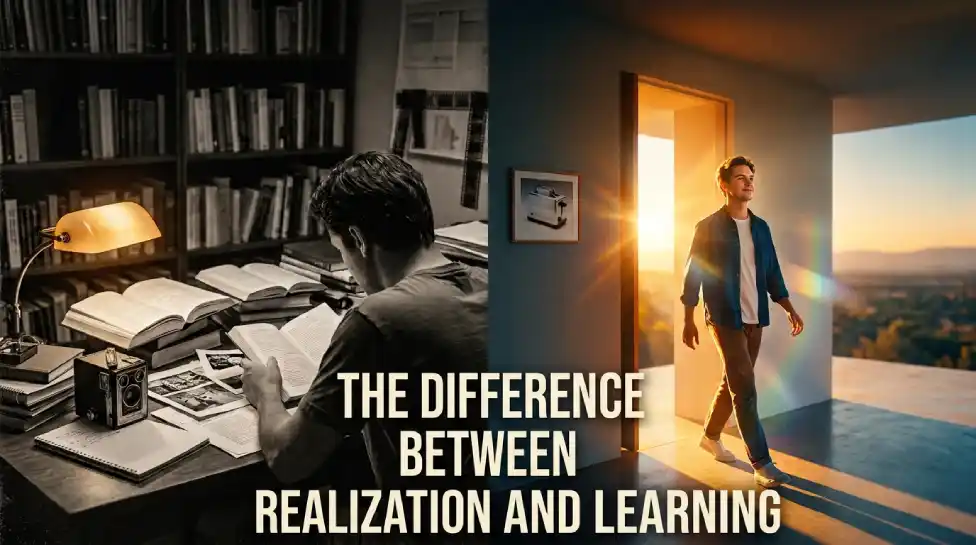
Why Knowing More Doesn't Always Make Us Wiser
"The greatest breakthroughs in life do not happen when we learn something new. They happen when we finally realize what we have known all along."
The Company That Invented the Future - But Couldn't See It
In 1975, a young engineer named Steve Sasson built something extraordinary inside Eastman Kodak's research laboratory.
It wasn't sleek. It wasn't portable. It certainly wasn't beautiful. The prototype weighed nearly four kilograms, looked more like a toaster than a camera, and took over twenty seconds to capture a single black-and-white image.
Yet that strange-looking device represented one of the most important inventions of the twentieth century.
It was the world's first digital camera.
The irony is almost impossible to ignore.
The company that would later become synonymous with the decline of film photography was the very company that invented the technology destined to replace it.
Kodak didn't lack intelligence.
It didn't lack engineers.
It didn't lack research.
It didn't lack innovation.
In fact, Kodak possessed something every organization dreams of possessing - the ability to see the future before anyone else.
And yet, history unfolded differently.
As the years passed, digital photography transformed from an experimental curiosity into a global movement. Consumers embraced it. Competitors invested in it. Entire industries began to evolve around it.
Kodak also entered the digital market, launching digital cameras and investing in imaging technologies. But while it understood the technology, it struggled to transform its business model with the same conviction that the changing world demanded.
The challenge wasn't simply technological.
It was psychological.
The company had learned about the future long before most of the world.
But learning alone wasn't enough.
The deeper realization - that digital photography would fundamentally redefine its identity - came too slowly.
Eventually, the industry moved faster than the organization could reinvent itself.
A Lesson Beyond Business
It is tempting to read Kodak's story as a lesson in corporate strategy.
But perhaps it is something far more personal.
How many books have we read on health while continuing unhealthy habits?
How many leadership seminars have we attended while leading in exactly the same way?
How many relationship articles have we consumed without becoming better listeners?
How many spiritual teachings have we admired without becoming more peaceful?
Information surrounds us.
Knowledge is available in seconds.
Learning has never been easier.
Yet transformation remains rare.
Why?
Because there is an enormous difference between learning and realization.
One fills the mind.
The other changes the person.
We Live in the Age of Learning
Never before has humanity had such unlimited access to knowledge.
Within minutes we can learn about neuroscience, artificial intelligence, climate change, investing, leadership, philosophy, psychology, or meditation.
Thousands of books.
Millions of videos.
Countless online courses.
Infinite opinions.
The modern world has made learning almost effortless.
Yet despite this abundance, anxiety continues to rise.
Leadership crises continue to emerge.
Organizations repeat familiar mistakes.
People know what they should do but often fail to do it.
This raises an uncomfortable question.
If knowledge alone could change human behavior, shouldn't we all already be living healthier, happier, and wiser lives?
Perhaps the problem isn't that we are learning too little.
Perhaps it is that we mistake learning for transformation.
What Is Learning?
Learning is the process of acquiring information, concepts, methods, or skills.
It expands what we know.
It answers questions.
It introduces possibilities.
Learning happens through books, teachers, mentors, conversations, experiences, observations, and even failures.
Without learning, civilization could never progress.
Every scientific discovery.
Every technological innovation.
Every philosophical idea.
Every artistic masterpiece.
Exists because someone first learned something new.
Learning is therefore essential.
But it is only the beginning.
Knowledge can live entirely inside the intellect.
A person may understand emotional intelligence without practicing empathy.
A manager may study leadership without inspiring trust.
An entrepreneur may know every business framework yet continue making reactive decisions.
Learning informs us.
It does not automatically transform us.
What Is Realization?
Realization is the moment when knowledge moves from the mind into consciousness.
It is no longer merely something we understand.
It becomes something we see.
Not intellectually.
Existentially.
Realization changes perception.
And when perception changes, behavior naturally follows.
No one needs to remind a person that fire burns after touching it once.
No motivational speech is required.
No checklist is necessary.
The realization itself changes future behavior.
The same principle applies throughout life.
People often know that time is precious.
They realize it only after losing someone they love.
They know health matters.
They realize it after illness.
They know relationships require attention.
They realize it when silence replaces conversation.
Learning tells us the truth.
Realization allows us to experience it.
Learning vs. Realization
Learning | Realization |
Acquires information | Transforms perception |
Expands knowledge | Deepens wisdom |
Happens through study | Happens through experience, reflection, or insight |
Changes what we know | Changes who we become |
Lives in memory | Lives in consciousness |
Can be borrowed from others | Must be discovered personally |
Often answers questions | Often changes the questions themselves |
Builds competence | Builds clarity |
Can remain theoretical | Always becomes practical |
Increases intelligence | Increases awareness |
The world rewards learning.
Life rewards realization.
One prepares us for success.
The other prepares us for significance.
Information Is Not the Destination
Modern society celebrates accumulation.
More books.
More certifications.
More podcasts.
More newsletters.
More productivity systems.
More information.
Yet there comes a point where another book does not solve the problem.
Another seminar does not create courage.
Another degree does not create wisdom.
Transformation begins only when knowledge becomes deeply personal.
That is the quiet moment when an idea stops being something we admire...
...and starts becoming something we live.
It is in that moment that learning ends.
And realization begins.
Reflection for Leaders
Leadership is often described as the ability to make better decisions.
But better decisions rarely come from acquiring more information.
They come from seeing familiar information differently.
History is filled with brilliant organizations that possessed extraordinary knowledge yet failed to recognize what that knowledge demanded of them. Kodak is only one example. Similar stories can be found across industries, institutions, and even personal lives.
The same pattern quietly unfolds within us.
We know that trust is built through consistency, yet we sometimes choose convenience over commitment.
We know that our health depends on daily habits, yet we postpone them until our bodies force us to pay attention.
We know that relationships require presence, yet we often realize their value only in absence.
The question, then, is not whether we are learning enough.
The question is whether our learning is changing us.
A conscious leader does not measure growth by the number of books read, courses completed, or ideas collected.
A conscious leader asks a different question:
"Which truth have I begun to live?"
Because information may impress others.
Knowledge may build competence.
But realization shapes character.
And ultimately, character is what people choose to follow.
Perhaps the purpose of learning is not to accumulate answers.
Perhaps it is to prepare us for the moment when a simple truth finally transforms the way we see ourselves, our work, and the world.
That moment is realization.
And that is where real leadership begins.
FAQs
1. What is the difference between learning and realization?
Learning is the process of acquiring knowledge, information, or skills. Realization is the moment when that knowledge becomes a lived understanding that changes your perception and behavior.
You can learn countless leadership principles, but you truly realize them only when they begin influencing how you lead every day.
2. Why is realization more powerful than learning?
Learning expands what you know.
Realization transforms who you become.
Knowledge can remain theoretical for years, while realization immediately influences decisions, actions, and relationships.
3. Can a person keep learning without growing?
Yes.
Many people consume books, podcasts, courses, and seminars without changing their habits or thinking.
Growth happens not through the quantity of information but through the quality of its application.
4. What is the difference between knowledge and wisdom?
Knowledge is knowing facts, concepts, or methods.
Wisdom is the ability to apply that knowledge with sound judgment, compassion, and perspective.
Knowledge answers questions.
Wisdom knows which questions truly matter.
5. How does realization happen?
Realization often emerges through reflection, experience, failure, meaningful conversations, or moments of deep awareness.
Unlike learning, realization cannot usually be forced. It arrives when knowledge connects with personal experience and changes how we see reality.
6. Why do intelligent people still make poor decisions?
Intelligence and realization are not the same.
A person may possess extensive knowledge yet continue making choices driven by fear, habit, ego, or short-term thinking.
Decision-making improves when knowledge is accompanied by self-awareness and reflection.
7. How can leaders move from learning to realization?
Leaders can cultivate realization by:
- Reflecting regularly on experiences.
- Seeking honest feedback.
- Applying one idea before chasing the next.
- Learning from failures instead of defending them.
- Creating space for thinking rather than constant doing.
Leadership grows through reflection as much as through education.
8. Is realization a one-time event?
No.
Realization is an ongoing process.
As people gain new experiences, familiar ideas often reveal deeper meanings.
The same lesson can be understood differently at twenty-five, forty, or sixty years of age.
9. What role does experience play in realization?
Experience gives context to knowledge.
Without experience, ideas often remain intellectual.
With experience, those same ideas become deeply personal and far more meaningful.
Experience alone, however, is not enough. It is thoughtful reflection on experience that creates realization.
10. Why is realization important in leadership and business?
Organizations operate in rapidly changing environments.
Leaders who merely collect information may react slowly.
Leaders who develop realization recognize patterns, anticipate change, and make decisions with greater clarity.
In business, competitive advantage often comes not from having more information but from understanding its significance before others do.
Final Thought
Learning opens the door to possibility.
Realization gives us the courage to walk through it.
The world has never had more information, more books, more courses, or more experts. Yet wisdom remains rare because wisdom cannot be downloaded - it must be discovered.
As you close this article, don't ask yourself, "What did I learn today?"
Ask yourself,
"What truth have I finally realized?"
That single question may change not only the way you think, but also the way you live and lead.
References
- IEEE Spectrum - The First Digital Camera Was the Size of a Toaster
https://spectrum.ieee.org/first-digital-camera-history - Kodak - Company Milestones
https://www.kodak.com/en/company/page/milestones/ - Kodak - Photography History
https://www.kodak.com/en/company/page/photography-history/ - Snopes - Did Kodak Invent the Digital Camera?
https://www.snopes.com/fact-check/kodak-digital-camera-invention/
Set the Trajectory
There are no reflections on this insight yet. Be the first to initiate the dialogue and share your perspective with the community.


Did this insight shift your perspective?
If this article resonated with you, what is one change or practice you will introduce to your workflow or leadership style moving forward? Share your commitment below.